
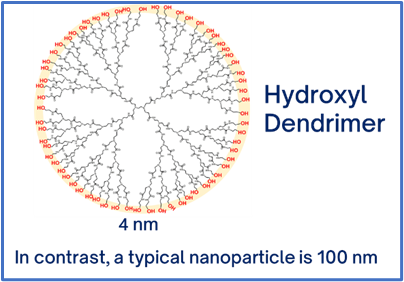
Design of cell-targeting (ligand free) dendrimers and dendrimer-drug conjugates (DDC’s).
We utilize the small size (~ 4nm), the high hydroxyl surface density, uniquely enabled by the dendritic architecture. In contract to what may be expected of these structures, they navigate the disease pathology exquisitely and unexpectedly to enable rather specific disease-cell targeting, opening new avenues for nanomedicines in unmet needs including in overcoming the long-standing challenges in delivering drugs across the blood-brain-barrier, and developing systemic treatments for retinal disorders.
Hydroxyl PAMAM dendrimer platforms for targeting reactive inflammatory cells in the brain, eye and beyond.
More than 20 years ago, our team discovered (and patented) compositions and the concept that hydroxyl dendrimer-drug compositions target reactive microglia and macrophages (without a need for targeting ligands). We have validated this in more than 50 models in six species including primates. The targeting to the site of pathology and subsequently to the reactive inflammatory cells is hydroxyl surface functional density dependent, ‘disease-directed’, and only dependent on the extent of injury, and is independent of receptor expressions. Therefore, it worked well in multiple clinical trials including in Phase 2 trials for severe COVID-19, and in age-related macular degeneration and diabetic retinopathy patients. The dendrimer-drug conjugates are cleared intact through the kidney, with minimal liver uptake and metabolism.
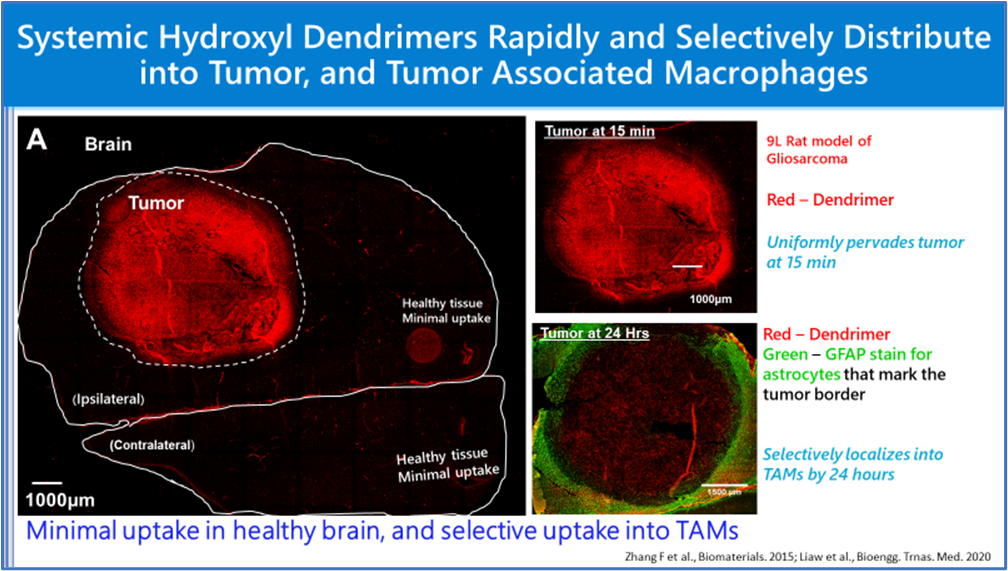
These images illustrates the exquisite, selective brain-tumor macrophage uptake of hydroxyl PAMAM dendrimers, from systemic administration.
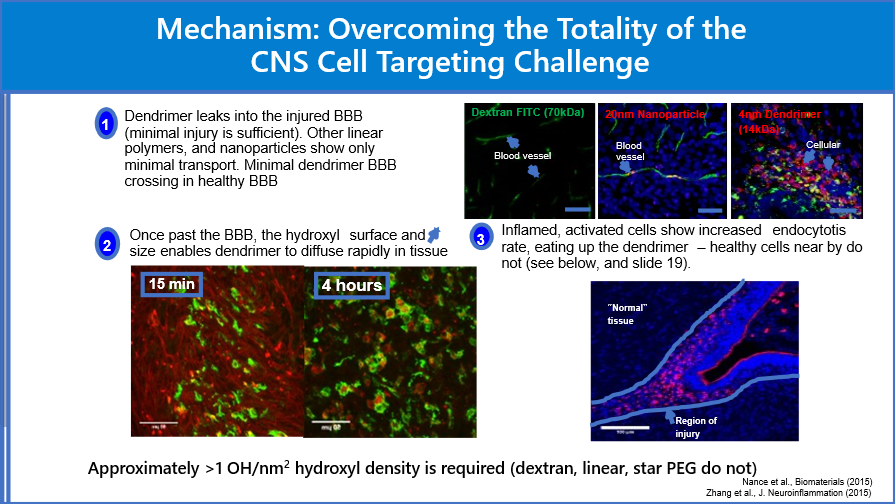
This schematic illustrates the mechanism of how the hydroxyl PAMAM dendrimer targets reactive microglia and macrophages in the affected parts of the brain, from systemic administration.
Please see the following references for more details.
References:
- Iezzi R, Guru BR, Glybina IV, Mishra MK, Kennedy A, Kannan RM. Dendrimer-based targeted intravitreal therapy for sustained attenuation of neuroinflammation in retinal degeneration. Biomaterials. 2012 Jan;33(3):979-88. doi: 10.1016/j.biomaterials.2011.10.010. Epub 2011 Nov 1. PMID: 22048009.
- Kannan S, Dai H, Navath RS, et al. Dendrimer-Based Postnatal Therapy for Neuroinflammation and Cerebral Palsy in a Rabbit Model. Sci Transl Med. 2012;4(130):130ra46. doi:10.1126/scitranslmed.3003162.
- Nance E, Zhang F, Mishra MK, Zhang Z, Kambhampati SP, Kannan RM, Kannan S. Nanoscale effects in dendrimer-mediated targeting of neuroinflammation. Biomaterials. 2016 Sep;101:96-107. doi: 10.1016/j.biomaterials.2016.05.044. Epub 2016 May 26. PMID: 27267631; PMCID: PMC5379995.
- Gusdon AM, Faraday N, Aita JS, et al. Dendrimer nanotherapy for severe COVID-19 attenuates inflammation and neurological injury markers and improves outcomes in a phase2a clinical trial. Sci Transl Med. 2022;14(654):eabo2652. doi:10.1126/scitranslmed.abo2652
